Baby toys by age, from 0 to 12 months
27 October 2026

Language
Language
In the first three months, getting used to the outside world is key. A newborn's eyesight is still limited. Babies see clearly at a distance of twenty to thirty centimeters, which is the exact distance to your face during feeding. They have a natural preference for human faces and strong contrasts, such as black-and-white patterns.
Their young nervous system gets overwhelmed easily. Toys with loud noises, bright flashing lights, or complex features are not needed right now.
What does your baby need? Your voice, scent, and closeness are the most important. A simple black-and-white contrast card or a calm mobile above the playpen is more than enough to look at.
Broemba's honest view: We consciously do not sell toys for this first stage. A newborn cannot grasp objects on purpose yet and does not put things in their mouth. Focus on giving your baby peace and comfort.
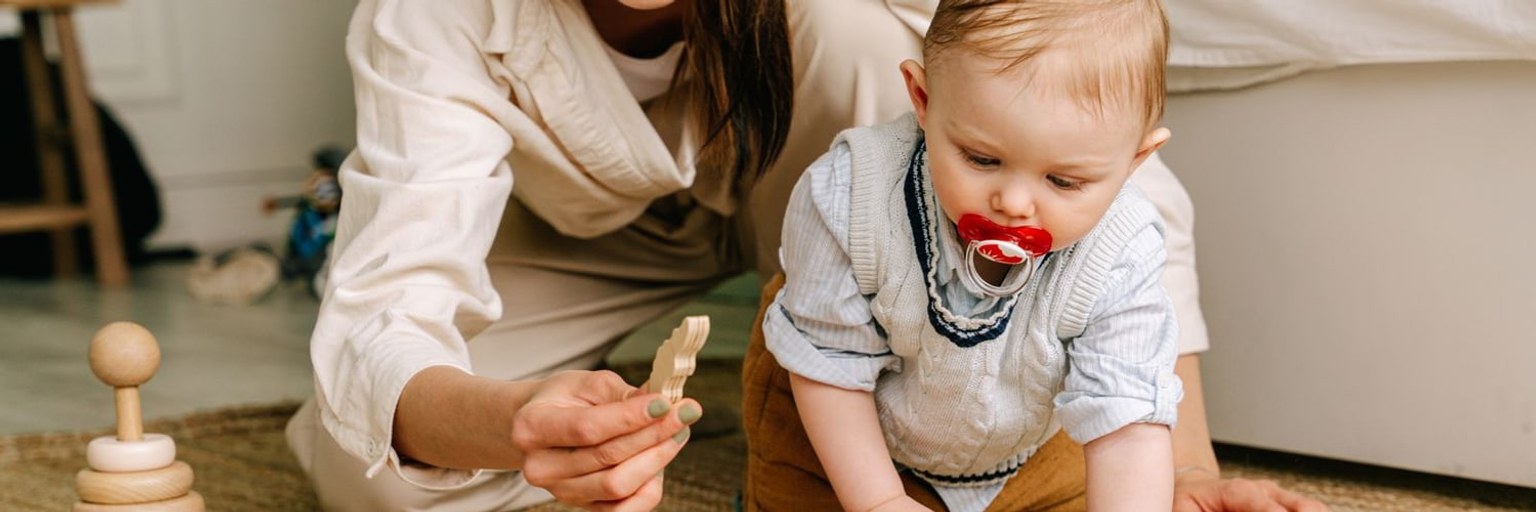
Between six and nine months, babies learn to sit upright on their own. Their hands are free to explore. Babies pass objects from one hand to the other and bang things together.
Around this time, you also start introducing solid foods.
What does your baby need? Toys that support motor skills, like soft balls, stacking cups, or touch-and-feel books. At mealtime, your baby also needs proper training tableware.
Matching products from Broemba: When starting solids, the Broemba fruit feeder with extra silicone teats is a great help. You place soft fruit inside the silicone nipple, so your baby can taste safely without any choking hazard. Our soft silicone training spoons help develop early motor skills at the dinner table.
A baby's first year is a time of rapid growth. In twelve months, a newborn turns into a curious toddler who sits independently, crawls, or takes those first careful steps. Every milestone brings new skills and needs.
Toy stores are filled with hundreds of items promising to speed up your child's development. But what does a baby really need at each stage? In this guide, we discuss your baby's development month by month and look at the power of simple toys without overstimulation. We keep things honest and down-to-earth: we explain what your child needs, even when Broemba chooses not to offer products for that stage.
Around three months, babies discover their own hands. They study their fingers and start reaching for objects. Between four and six months, they get much better at reaching out and holding onto toys.
This is also when the oral stage begins. The sense of touch in the lips and tongue is much sharper than in the fingertips right now. To discover how an object feels, babies put everything in their mouth. At the same time, the first teeth often start coming through. This causes tender gums and the urge to chew.
What does your baby need? Lightweight toys without sharp edges, made from safe and non-toxic materials. Because everything goes into the mouth, toys should never have loose parts or batteries.
Matching toys from Broemba: In this stage, our silicone teethers are a perfect fit. Our designs are made from solid, food-grade silicone:
These toys contain no electronics, are easy to rinse under the tap, and provide safe pressure on sore gums. We also offer affordable bundle sets such as set Bari, set Como, and set Rome.
In the final months of the first year, babies become very active. They roll, crawl, and pull themselves up against furniture. They discover cause and effect and practice their pincer grasp.
What does your baby need? Toys for gross motor skills: wooden baby walkers, large soft blocks, shape sorters, and balls to chase after.
Broemba's honest view: Broemba does not sell wooden blocks or baby walkers. You can find those toys elsewhere. Our products mainly help at mealtime: our silicone bib with food catcher catches dropped food while your little one learns to eat. And when the first molars come through around their first birthday, our teethers provide reliable and safe relief. Read more in our guide on suitable toys for a 1-year-old child or browse our selection of practical baby gifts.